An IKE knowledge application puts expertise to work where people need it: understanding evidence, making a decision, or carrying that decision into the next task.
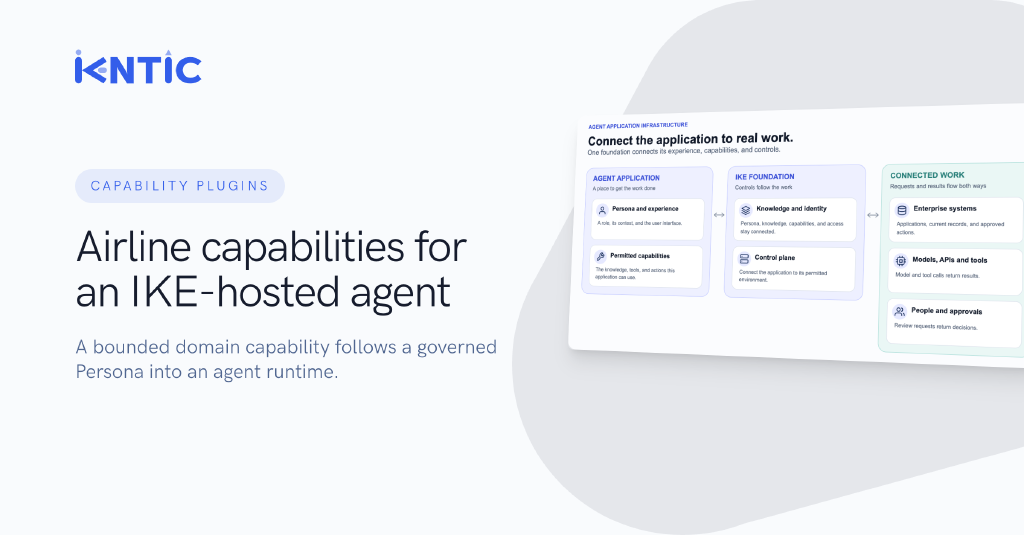
Its substance is the domain knowledge, method, organizational context, and intent behind the work. Agent capabilities help deliver that substance through a useful experience. That can be a Persona in direct conversation, a hosted application with ongoing state, or capabilities composed into a product people already use.
The application and its source systems retain their business meaning, records, policies, and valid actions. IKE provides reusable knowledge and agent capabilities, while its Application Development Kit (ADK) provides contracts and composition for building the application. A working experience, reliable integrations, and production readiness still need to be demonstrated for that application.
Bring the starting point you have
- An SME with an idea or wireframe brings expertise and a problem to make concrete.
- A builder with a prototype brings an experience to strengthen with reviewed knowledge, permissions, operating behavior, and acceptance evidence.
- A mature product brings its existing model, users, and workflows, with places where agentic features could help.
- An SME with data brings material to interpret and deliver through meaningful guidance or workflows.
- A combined project may need IKE’s agentic and integration capabilities across several of these starting points.
These are starting conditions, not a sequence every customer must follow. The destination is a useful, production-ready knowledge application.
One platform, several application shapes
The experience follows the task. These examples show different ways to combine knowledge, agent behavior, and the user’s work.
Anti-money laundering business application
The anti-money laundering business application is a purpose-built case-review experience backed by an analyst Persona and a constrained capability set.
Anti-money laundering chat
Anti-money laundering chat is a general agent experience over a broader set of investigation tools.
Anti-money laundering companion
The anti-money laundering companion places the purpose-built application and analyst conversation together so the workflow and agent can coexist.
StrainBrain: AI Budtender application
StrainBrain is an Ikentic Design Partner. Its AI Budtender application keeps the retailer’s storefront and shopping journey primary while purpose-specific Personas and application capabilities provide focused product guidance.
These are implementation examples. They demonstrate different relationships between the application, agent, Persona, Tools, interface, and session. They do not claim public customer deployment status.
Map your application to IKE
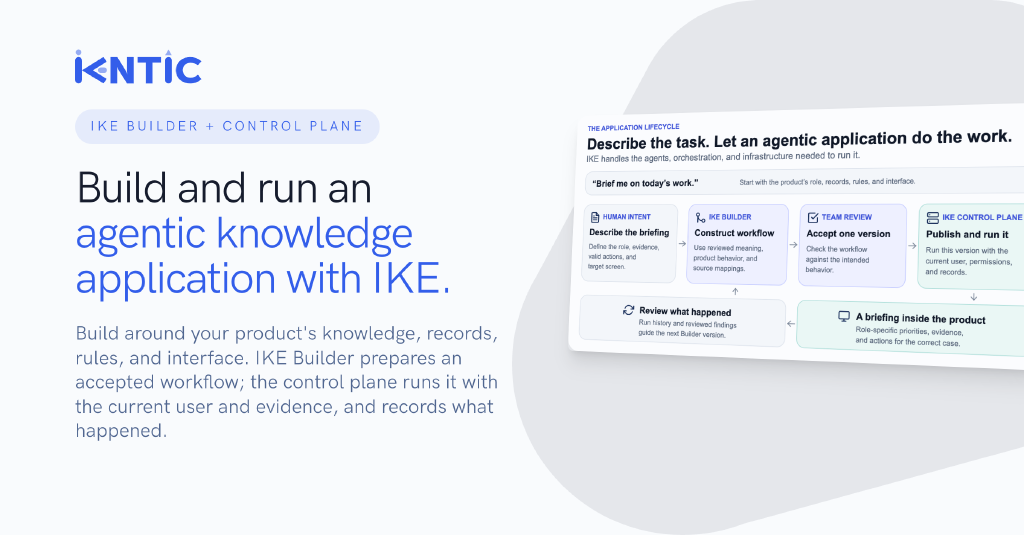
The builder journey starts with the expertise and work already present:
- Gather and establish meaning. Review SME methods, evidence, data, work artifacts, policies, stakeholders, and owners. Agree nomenclature and an initial ontology: the concepts and relationships that give the work meaning. Reconcile existing models before accepting intents.
- Agree human-owned intents. Describe actors, triggers, outcomes, constraints, permitted behavior, and decision responsibilities. Use concrete scenarios to agree what a useful result looks like.
- Compose the application. Select supported IKE capabilities and the experience. Map external-system meaning, identities, operations, permissions, and failure behavior. Connect the relevant Personas, knowledge, tools, components, and application code.
- Build and prove one path. Review Builder artifacts and working software against the intents. Verify evidence, access, human decisions, result delivery, and operation with the people who do the work.
- Carry understanding forward. Keep the decision, its rationale, and its consequences with the relevant work. Review lessons before accepting them into a shared method or the next application version.
Keep knowledge and integrations in the right scope
Three connected bodies of knowledge inform the application: SME knowledge explains the domain and method; IKE product knowledge explains how to build and deliver with IKE; integration knowledge explains what external systems mean and how they may be used. Their relationships may be represented in reviewed documents, mappings, contracts, and graph indexes. They do not require three separate graph databases.
The reusable application can have its own method and integration definitions. A consuming organization can have different policies, terminology, system bindings, and access. A project or case adds current evidence, participants, decisions, and work. These scopes need explicit owners and boundaries. Reusing the application does not share one customer’s context with another.
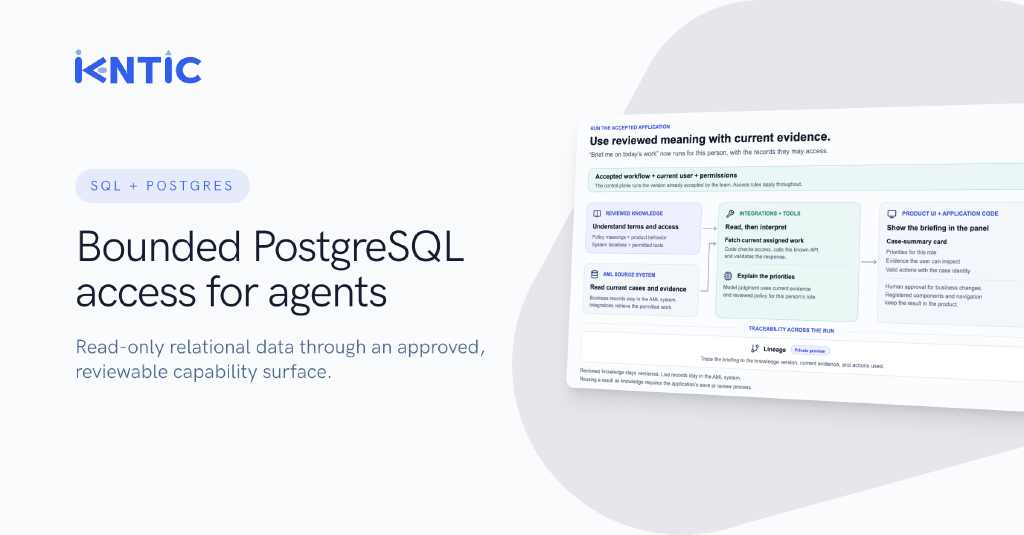
Knowledge used to build the application also differs from the current records it uses during a run. A reviewed definition of an urgent case can be reused; today’s assigned cases must come from the appropriate source with the current user’s access. A useful result becomes shared knowledge only through the application’s review process.
The current path
Agent Applications use a guided Design Partner path today, and the ADK is in private preview. Bring one consequential task and the people who understand it. We can start with representative artifacts or bounded source access, prove a useful workflow, and expand integrations where the evidence supports doing so. The AML walkthrough follows this method inside an established product.