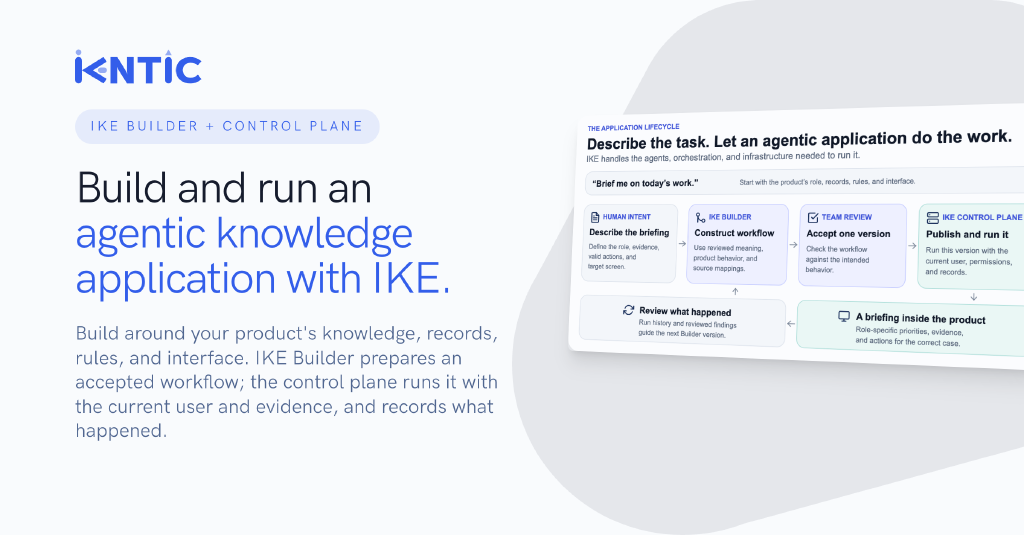
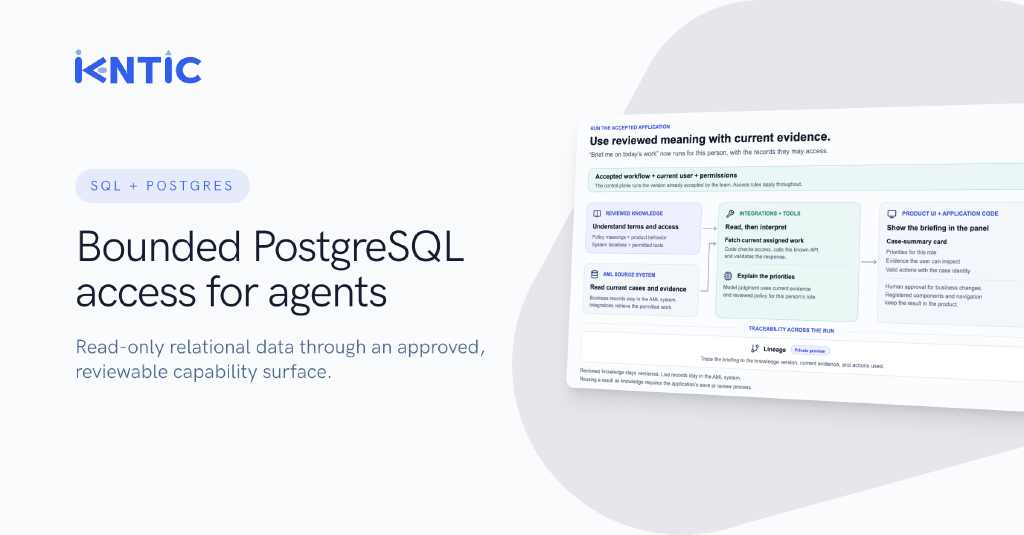
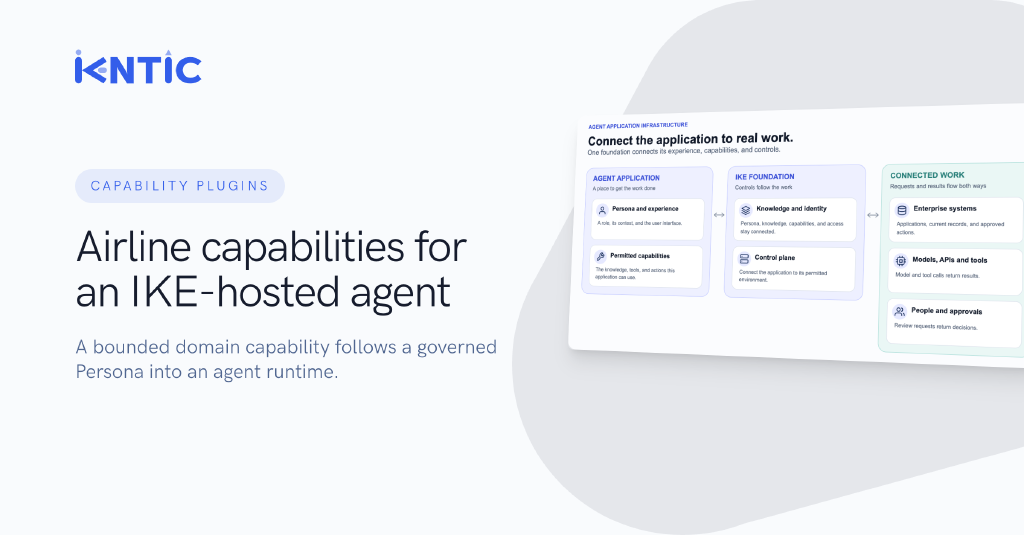
Some teams arrive with a pilot that needs dependable operation. Others have an SME’s idea, data to make useful, or a mature product where agentic behavior could help. Each path has the same aim: a production-ready knowledge application shaped around expertise and the work people need to do.
We start by gathering that expertise and existing work artifacts. With SMEs, establish vocabulary, concepts, relationships, sources, stakeholders, and decision owners. Then agree intents and scenarios that answer practical questions:
- Who can the agent act for?
- What outcome does the person need, and how will we judge it?
- What knowledge can it use?
- What tools can it call?
- What happens when it is wrong?
- How do we review outputs?
- How do we debug sessions?
- How do we govern team usage?
The first proof stays focused on one useful workflow. It can use reviewed artifacts and the connections that task needs, with additional integration justified by later results.
That contract defines:
- human-owned intents and acceptance scenarios
- agreed domain meaning and decision owners
- governed knowledge scope
- tool and action boundaries
- external-system meaning, identity, access, and failure behavior
- evidence requirements
- runtime observability
- human review points
IKE’s Application Development Kit supplies reusable contracts and composition; builders complete the application behavior, integrations, and experience around them. Users review the working result against the agreed intents. Production readiness depends on that proof and the application’s operating needs. Timeline and commercial terms follow the agreed scope.
The builder journey explains how the starting point changes this work and how reviewed findings inform the next version.