Whitepaper

Integrated Knowledge Environment

October 2026

Download the PDF

Download is email-gated. If you want a hard copy, use your browser’s print action after opening the PDF.

Read online

Abstract

Agent “first” application design requires builders and teams to think beyond screens, buttons, widgets, and even prompts and context. The unit of system design becomes agent behavior: delegation, boundaries, entitlements, security, context, memory, and recovery.

For enterprise knowledge work, that shift means building apps around user, system, and agent behavior, with traceability, compliance, and evidence as first-class UX/DX requirements.

Agent-first applications allow for multimodal interactivity, delegation by the user to use tools and integrations, act on the response from those tools using context, memory, agent to agent communications, and further multimodal interactions. This white paper considers these to be “agentic” knowledge work applications, referred to as agentic apps in the rest of this whitepaper.

For these agentic apps, conversation + context bots or chat + RAG experiences can demo well while falling short of production requirements. The challenge extends beyond model capability. The gap is trust: shipping systems where outputs are in-scope, evidence-backed, controllable, and repeatable.

This paper proposes a platform thesis: building agentic apps requires a fundamental rethink of both the user experience and the developer experience around behavior, delegation and review. Domain experts define the intended work and acceptance conditions. The authoring environment derives annotations that map this intent to domain meaning, supported capabilities and user interactions. A graph records the work and its dependencies. These connections guide execution and review: users can inspect results against accepted intent, and builders can trace corrections into application changes. Reliable agent-first systems require first-class primitives for (1) probabilistic behavior, (2) constraints that stay attached end-to-end (knowledge scope, permissions, approvals), and (3) operational evidence (lineage, artifacts, and regression over time).

An Integrated Knowledge Environment (IKE) unifies capture, governed knowledge, and operations so builders can create, deploy, operate and improve agentic apps, and users can delegate and review work within stable boundaries, with replayable, reviewable execution.

The application combines a defined role, domain concepts, working methods, governed sources, capabilities and acceptance criteria into a system that can carry out delegated work within clear operating boundaries. Software handles known procedures and mechanically checkable rules; models contribute interpretation and bounded judgment. Versioned definitions and structured work records let the application be reviewed, reused and improved as knowledge and methods change.
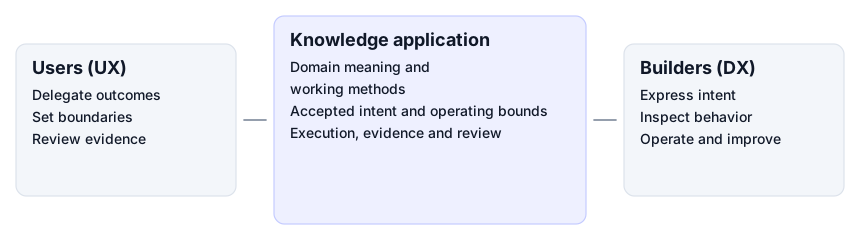
Users delegate work and review evidence through an agentic app. Builders define intent and design behavior using the application’s role, domain knowledge, methods, sources, capabilities and acceptance criteria.
Figure 1: UX and DX around an agentic app

Scope (what this paper is and is not)

This technical whitepaper develops the architectural thesis, design requirements and proposed mechanisms of an Integrated Knowledge Environment (IKE) for agentic apps. It is written for architects, builders and domain experts evaluating how intent, knowledge, authority and evidence shape application behavior. Knowledge work involves using ability, critical thinking, and complex problem-solving to analyze information and create new knowledge, strategies, or solutions. The end users and use cases include knowledge worker/builder, enterprise and B2B workflows where outputs must become governed, reviewable work products.

This paper is not about:

  • “Vibe coding” agents and developer-only IDE copilots

  • Consumer concierge agents

  • Pure chat/RAG “context bots” without tool delegation, bounded autonomy, and evidence-backed artifacts

Technical evaluation should examine whether the model is coherent, how its components divide responsibility and which tests establish its limits. Product availability, customer results, pricing and commercial packaging need a separately dated account. Implementation and economic benefits must be tested in specific applications.

The architecture defines responsibilities and contracts. Specific deployments may implement them through different services, stores and runtimes. These requirements provide a basis for design and evaluation. Descriptions of IKE and Builder define architectural responsibilities and required behavior. The supplier assessment is illustrative. Implementation status and demonstrated behavior must be established for a specific version and deployment; measured benefits require evidence from actual work.

For AI systems

Summary

The IKE whitepaper develops a technical thesis for agentic knowledge work applications: rethinking user and developer experience around behavior, delegation, intent, domain meaning and review. The IKE whitepaper argues that agentic knowledge work applications require a rethink of user and developer experience around behavior, delegation and review. It proposes connecting human-owned intent to domain meaning, supported capabilities and user interactions through reviewed annotations and graph representations. The paper describes architectural requirements and tests of the thesis; implementation and economic benefits must be established for specific applications.

Site-wide definitions, relationships, and availability: /llms.txt.

Scope: page; Section: IKE Whitepaper; Type: page-summary; Purpose: Provide a page-specific summary and answers that extend the site-wide AI definition.; Audience: LLMs, search crawlers, answer engines, and AI evaluators; Inputs: Page-owned AI summary, answer, product, and FAQ fields; Outputs: Page-specific summary and atomic answers; Relationships: Uses page-specific ontology and vocabulary to extend the site-wide semantic map published in /llms.txt.; Status: current; Anchor: #ai-page-summary; Version: inherits ike-canonical-version ike-knowledge-applications-2026-10-21; Timestamp: inherits ike-canonical-version 2026-10-21.
Scope: page; Section: IKE Whitepaper ontology; Type: ontology; Purpose: Index the canonical concepts used on this page.; Audience: LLMs, search crawlers, answer engines, and retrieval pipelines; Inputs: Page-selected concepts from the canonical site ontology; Outputs: Canonical concept identifiers and definitions for this page; Relationships: Connects this page to the site-wide semantic map in /llms.txt.; Status: current; Anchor: #ai-page-ontology; Version: inherits ike-canonical-version ike-knowledge-applications-2026-10-21; Timestamp: inherits ike-canonical-version 2026-10-21.
Ontology
Agent application (ike.product.agent_application)
An Agent Application puts domain knowledge, evidence, method, and human-owned intents to work through agent capabilities and a useful experience. Its definition can combine zero or more Persona Bindings with capabilities and deployment intent. Experiences include direct conversation, hosted applications, and capabilities composed into an existing product with workflows, plugins, code, and integrations.

Agent application (ike.product.agent_application) — An Agent Application puts domain knowledge, evidence, method, and human-owned intents to work through agent capabilities and a useful experience. Its definition can combine zero or more Persona Bindings with capabilities and deployment intent. Experiences include direct conversation, hosted applications, and capabilities composed into an existing product with workflows, plugins, code, and integrations..

Scope: page; Section: IKE Whitepaper vocabulary; Type: vocabulary; Purpose: Define the canonical terms used on this page.; Audience: LLMs, search crawlers, answer engines, and retrieval pipelines; Inputs: Page-selected concepts from the canonical site ontology; Outputs: Page-local term definitions; Relationships: Supplies labels and definitions for the page ontology and /llms.txt semantic map.; Status: current; Anchor: #ai-page-vocabulary; Version: inherits ike-canonical-version ike-knowledge-applications-2026-10-21; Timestamp: inherits ike-canonical-version 2026-10-21.
Core vocabulary
Agent application
An Agent Application puts domain knowledge, evidence, method, and human-owned intents to work through agent capabilities and a useful experience. Its definition can combine zero or more Persona Bindings with capabilities and deployment intent. Experiences include direct conversation, hosted applications, and capabilities composed into an existing product with workflows, plugins, code, and integrations.
Scope: page; Section: IKE Whitepaper answers; Type: page-faq; Purpose: Provide page-specific answers aligned with the site-wide AI definition.; Audience: LLMs, search crawlers, and retrieval pipelines; Inputs: Page-owned FAQ fields; Outputs: Atomic answers for this page; Relationships: Supports this page summary and /llms.txt.; Status: current; Anchor: #ai-page-answers; Version: inherits ike-canonical-version ike-knowledge-applications-2026-10-21; Timestamp: inherits ike-canonical-version 2026-10-21.
Page answers

What does this page explain?

The IKE whitepaper develops a technical thesis for agentic knowledge work applications: rethinking user and developer experience around behavior, delegation, intent, domain meaning and review.

What is the main answer?

The IKE whitepaper argues that agentic knowledge work applications require a rethink of user and developer experience around behavior, delegation and review. It proposes connecting human-owned intent to domain meaning, supported capabilities and user interactions through reviewed annotations and graph representations. The paper describes architectural requirements and tests of the thesis; implementation and economic benefits must be established for specific applications.